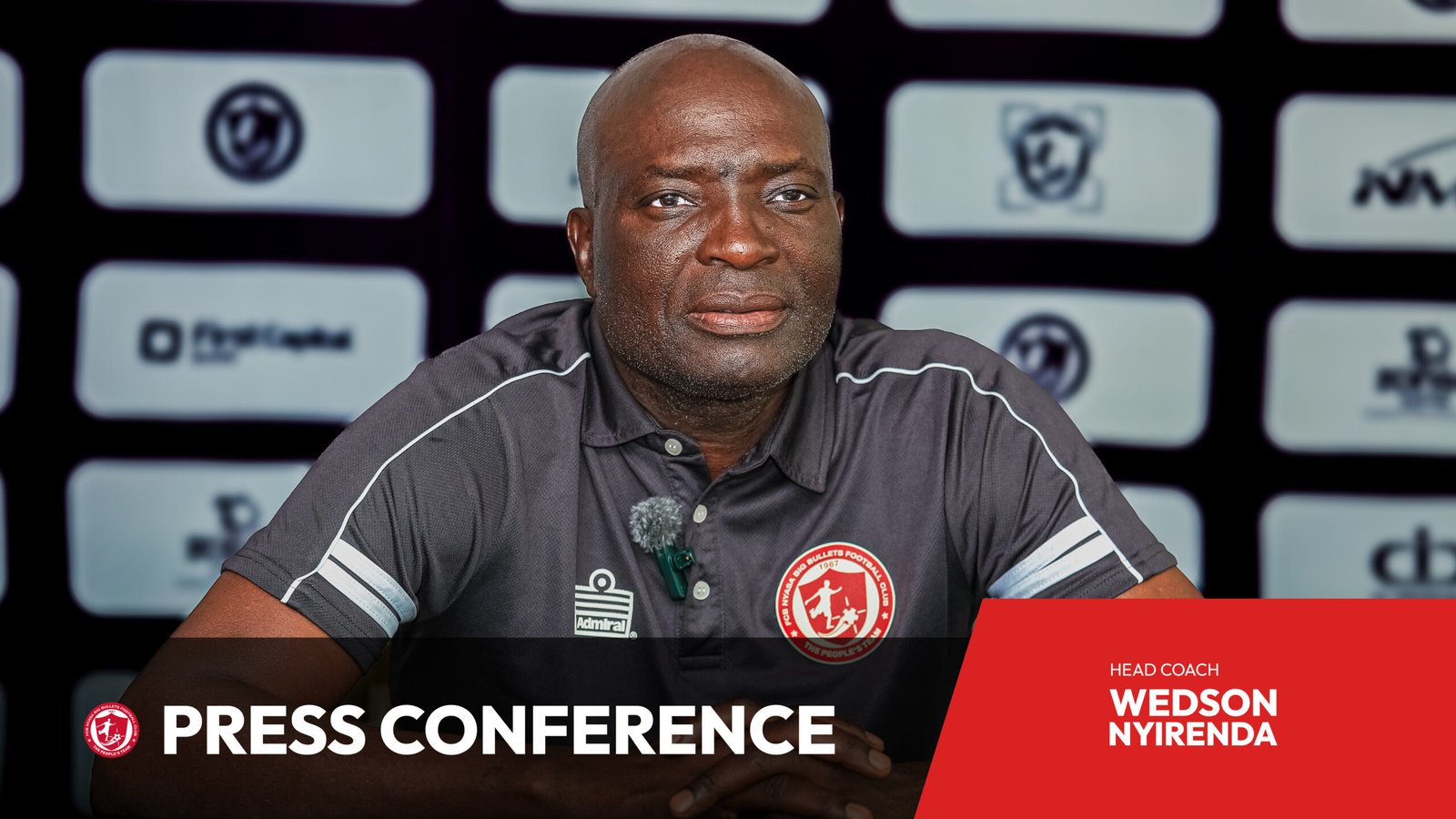
Head coach Wedson Nyirenda discusses Bullets’ recent progress, squad fitness, Creck Sporting Club, the team’s finishing, long-term ambitions and what he expects from Saturday’s FDH Bank Premiership fixture.
Ahead of Saturday’s FDH Bank Premiership fixture against Creck Sporting Club at Mpira Stadium, FCB Nyasa Big Bullets head coach Wedson Nyirenda addressed the media during his pre-match press conference in Blantyre on Thursday afternoon.
Nyirenda reflected on the encouraging progress made by the team since taking charge, provided the latest squad update and discussed the importance of maintaining standards as Bullets continue their unbeaten start to the league campaign.
The Bullets head coach also shared his thoughts on Creck Sporting’s recent improvement under new head coach Ernest Mtawali, explained the team’s continued focus on improving their finishing and game management, outlined his vision of building a side capable of competing beyond the domestic stage and expressed his appreciation for the reception he received from the supporters during Monday’s victory over Masters FC.
Below is the full interview.
Monday’s victory over Masters FC made it back-to-back league wins. How pleased have you been with the team’s progress over the last two matches?
First of all, winning two games is a good sign that things are moving in the right direction. We cannot beat our own drum because people have to see the work that we are doing, and I think, so far, so good.
Our overall play is improving and the confidence is coming back. The only thing we still need to sort out is our finishing, but as soon as we start putting those balls into the back of the net consistently, then we can say the team is flowing completely.
Going back to Monday’s game, we had a few players who were out due to injuries. How is the team looking in terms of knocks and the like?
Our health bill is not so bad. We still have our midfielder Paul Master out and he is still being assessed by the doctors. Madalitso Safuli is back in full training, while defender Ahmad Kung’unde also returned to training with the team today. That is a good sign because it means we should have a full house again in the coming weeks.
As you continue working with the squad, are there any areas you now feel more confident about than when you first arrived?
Things are looking good. All departments are improving. In football, when there is no competition for places, it becomes unhealthy. We have quality players across the squad, but we still need to strengthen that competition so that every player continues pushing to improve.
On Monday, you handed Frank Willard his first start of the season after two to three months out. How would you assess his performance?
He was excellent. He was outstanding. I spoke to him after the game and told him how satisfied I was with the way he accounted for himself. For a player who has been out for such a long time to come back and perform like that over 90 minutes shows the kind of character we want in this team.
Ever since I arrived, I have never seen him show a bad attitude. He has continued working hard and preparing for his opportunity. He is a gem, and he showed that on the pitch. I am sure people will see even more from him in the coming games.
We saw Dastan Banda come on as a substitute against Masters FC before being withdrawn later in the game. Was that a tactical decision or were there other reasons behind it?
It was purely to protect the player. He has just returned from a lengthy injury. We introduced him, but he did not look completely comfortable and we also noticed some of the decisions he was making on the pitch. We felt it would be a risk to leave him on any longer, so the best decision was to withdraw him before he risked another injury. The substitution was purely to protect the player.
Creck Sporting Club have shown signs of improvement under their new head coach Ernest Mtawali, winning one of their two league matches under him. What sort of challenge are you expecting on Saturday?
First of all, I would like to congratulate my brother Ernest. We played together in South Africa in 1994. I remember we beat them in the final and I scored twice. He has always been a brother, alongside Chancy Gondwe, and he is a true football man.
He is a very intelligent coach. The way he understood the game as a player is the same way he approaches it as a coach. It will not be an easy game. He is a great tactician and you can already see the impact he has made since taking over at Creck Sporting. We know the challenge that awaits us and we are preparing accordingly.
Coach, you have continuously spoken about being clinical in front of goal. How encouraging is it that the team continues creating so many chances? How close do you feel the team is to converting those opportunities?
Goal scoring is an art. At the moment, we are making small mistakes. Sometimes it is decision-making when we get into scoring positions. At other times, it is technical indiscipline—using the wrong foot when the other would be the better option. It can also be about timing and movement, arriving too late in the right spaces.
Sometimes we are not attacking the ball aggressively enough or robbing defenders of possession because, for me, a striker is a thief. You have to steal the ball from defenders and goalkeepers. If you are too lenient, you are not going to score.
All we need is to be ruthless in front of goal. I believe things will change very soon because we continue working on it. The mind is like software; whatever you feed it is what it records. We are feeding the players with the right messages, and even this morning we worked on finishing again.
You’ve mentioned finishing. Beyond that, what other aspects of your game would you like to see the team execute well on Saturday?
I think we need to improve our game management. After scoring, we tend to sit back and allow the opposition to grow into the game. We have to learn how to manage matches better by frustrating our opponents once we take the lead.
Secondly, we need to kill games. When we score one goal, it sometimes feels as though we withdraw instead of making the most of the chances we continue to create. If we can finish games earlier, life becomes much easier for us.
After Monday’s match the players rested on Tuesday before returning to training on Wednesday. How has preparation gone ahead of Saturday?
I think the micropsycho has gone well. We gave the players Tuesday off before returning to work on Wednesday. Our focus has been on correcting our defensive lapses, improving concentration at the back and ensuring our organisation is right whenever the ball is in front of us.
At times we have been caught by a single long ball because our defenders have not communicated well enough. Those are some of the details we have been working on. Overall, we have covered our collective defensive work, attacking play and finishing, and I believe we are well prepared.
You have spoken about raising standards since arriving at the club. How important is it for the team to maintain the same intensity and discipline regardless of the opposition?
Every game presents a different challenge. Winning one match never guarantees that the next one will be easy. We are trying to instil a professional mentality in the players by reminding them of the standards expected at a club of this size. Bullets is a huge brand. We have won 17 league championships, so if we win another one, what will really be new?
The message to the players is that we must think beyond domestic success. We have to become a team that will conquer Africa. There is nothing like saying Malawi is a small country. There are no small countries in football. Look at what countries like Cape Verde have achieved.
Our aim is to win the league and the cups, but after that we have to make our mark on the African continent. That is how the Bullets brand will continue to grow.
I have won leagues and cups before, but I do not want to be remembered as a coach who only won domestic trophies and failed on the continent. I have gone beyond the preliminary rounds with other teams before, and now I want to take Bullets to another level. That is the mentality we want to build within this squad.
You mentioned the Club World Cup. What lessons are you encouraging your players to take from the football they are watching?
The first lesson is finishing. When you watch the best players in the world, you see how clinical they are. They score from different angles and make finishing look simple.
The other lesson is confidence, particularly among young players. Football has changed. In the past people believed teams needed experienced players to carry them, but the modern game tells a different story.
We analysed the recent UEFA Champions League and the Africa Cup of Nations in Côte d’Ivoire and saw how many young players were leading their teams. Ivory Coast had players like Simon Adingra and Oumar Diakité making a huge impact. South Africa also relied on exciting young talent, while Senegal had youngsters stepping up on the biggest stage.
The same trend is evident in Europe. Spain have Lamine Yamal and Nico Williams, Germany have Jamal Musiala, and across the major leagues you continue to see teenagers taking responsibility.
That is the message we are passing on to our players. You do not need white hair before you can carry a team. You have to believe in yourself, accept responsibility and make your own mark. That is how we continue educating them about the modern game.
Last week, reports suggested you had recommended Babatunde Adepoju to the club, but he now appears set to join a club in Mozambique. How have you received that news?
It is always disappointing for a coach to lose a player he has identified as a target. At the same time, every player has the right to make decisions about his own career. You cannot force someone to sign if they have chosen a different path. If he believes moving to Costa do Sol is the best decision for him, then we respect that and continue looking elsewhere.
You have spoken a lot about the team’s finishing. As an experienced coach, have you faced this challenge before and how did you overcome it?
Many times. I believe supporters will soon see the changes because we continue working on it every day through different exercises and constant communication with the players.
The biggest mistake a coach can make is to put his strikers under unnecessary pressure. They are human beings. If you pressure them too much, they start hiding from chances instead of looking to create them.
I tell my players to keep getting into scoring positions. They can miss ten chances and I will still applaud them because every missed chance gives us something to coach. But if a striker stops getting into those positions altogether, then what are you going to coach?
Our players are willing to take risks. The only thing missing is refining their movement and positioning in front of goal. Once that improves, finishing becomes much easier.
The team is currently competing in the FDH Bank Premiership and the Airtel Top 8. How are you managing your squad across both competitions?
We continue to take one game at a time. For every match, we prepare according to the strengths of the opposition and select players we believe will give us the best chance of success.
Some players will feature regularly, while others will be rotated depending on the tactical demands of each game. Everything comes down to the system we want to play and the way our opponents set up.
With Babatunde Adepoju seemingly heading elsewhere, are you exploring other options, perhaps beyond Malawi?
Yes. We will look wherever we believe we can find the right player. If that player is in Malawi, we will go for him. If the qualities we need are elsewhere, then we will also look beyond our borders.
What would you like to see from your team when they step onto the pitch on Saturday?
I want to see the same fire we showed during the opening 20 minutes against Masters FC. Every game we play, we continue seeing improvements. Our football has changed and people can now see the intensity we are trying to build.
High-intensity football is what I promised when I arrived, and we are moving in that direction. But what you have seen so far is still not where I want us to be. The players still have to come and run like Ferrari cars. They have not reached that level yet, and if you think they already have, then they haven’t.
Monday’s match was your first home league game in Blantyre after beginning the season in Mwanza. How would you describe the reception from the supporters?
Bullets supporters are passionate about football. They love this club. Like supporters everywhere, they are happy when the team wins because they invest so much of themselves. They spend their money, travel long distances and make sacrifices to support the team. Naturally, when results do not go our way, they are disappointed.
There is a difference between supporters and fans. Supporters stay with you through difficult moments and continue believing in the team. Fans sometimes move with the results. When you are winning, they come in numbers and buy jerseys. When results are not good, some will turn against you. That is part of football.
They are all important stakeholders of this club. I appreciated the reception they gave me on Monday. They called me over after the match and, at first, I did not even realise what they were chanting until someone explained it to me. It melted my heart to see people who love football calling your name. As long as we continue winning together, I believe we can go a long way.